Why a 0 ms Transfer Switch Matters for PCs, Medical Gear, and Your Fridge
What “instant” actually means
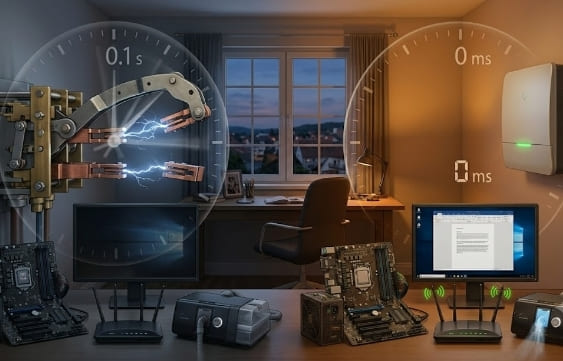
“0 ms” means the switchover happens with no perceptible interruption — the load never sees the grid disappear. Traditional automatic transfer switches introduce a measurable delay, often between 10 and 100 milliseconds, because a mechanical switch has to physically move. A battery that’s already running can hold voltage steady through the transition, which is exactly what a gateway that switches without a perceptible gap is built to do — so anything plugged in keeps humming.
RemonterWhere the gap bites
For a lamp, a few seconds of darkness is nothing. The trouble is everything with a clock or a chip in it. Research from Lawrence Berkeley National Laboratory has long noted that even a brief voltage sag or dropout can cost as much downtime as a full hour-long outage, because equipment has to reboot, reconnect, or restart a process once power returns.
The examples pile up fast. A desktop without its own battery loses whatever wasn’t saved. A furnace control board can fault and need a reset before heat comes back. A video call drops, a smart-home hub reboots, and a home server may corrupt a write that was mid-flight. None of these is a disaster alone, but together they turn “the power blinked” into an evening of restarting things one by one.
This is the practical reason home batteries get described as whole-home UPS units. Because the inverter is online and the energy is already stored, systems like the ones Sigenergy builds carry the load through a grid failure with no gap, so sensitive devices never register the switch at all.
RemonterDoes everyone need zero?
No. A household backing up a fridge and some lights can live with a short pause. But for home offices, networking gear, sump pumps with delicate controls, or any health equipment, switching speed quietly becomes the most important number on the spec sheet — ahead of capacity, ahead of price.
If anything in the house can’t tolerate a flicker, it’s worth confirming how quickly a system actually transfers before buying on kilowatt-hours alone.
Remonter